
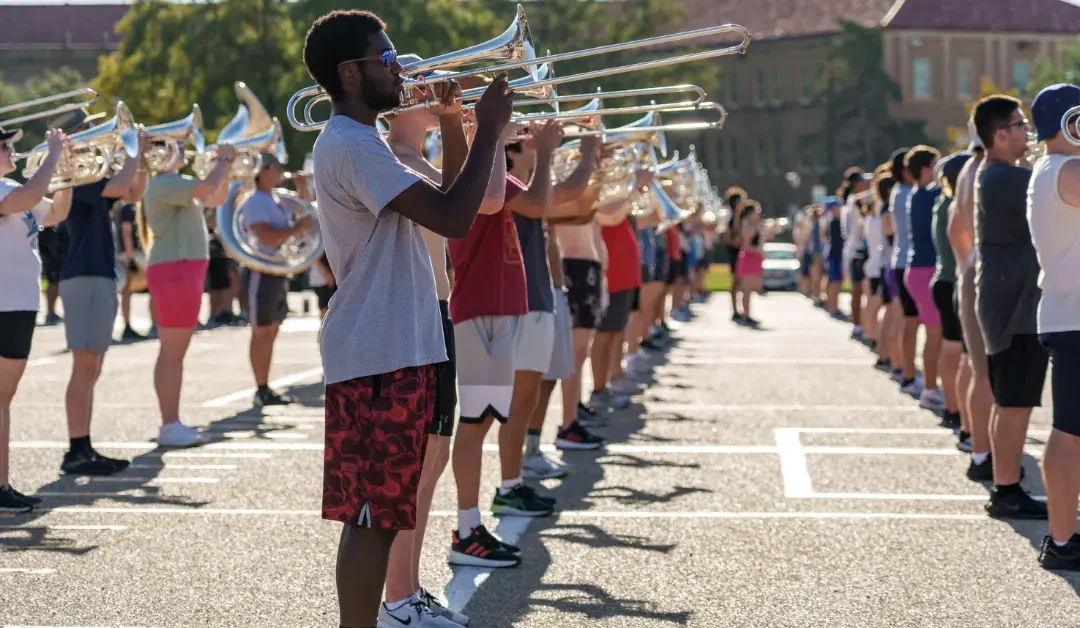
Directors spend a lot of energy picking the right concept, assuming the theme itself will make students care. I used to think that way too. But I have watched an emotionally rich concept fall flat because of how staff introduced it. I have watched a fairly plain concept generate real student ownership of your show. The difference came down to how the room rehearsed it.
The show you choose matters. However, how you build the room around it matters just as much. It is the part directors talk about far less. These five habits are not about what kind of show you pick. Instead, they are about what you do in the room once you have picked it. They work regardless of whether your concept is emotional, entertaining, or somewhere in between.
1. Explain the why before the what
Most seasons start with a folder of music and a drill packet. Students learn notes and sets before anyone has told them what any of it is actually for.
That sequencing quietly teaches students that meaning is optional, something staff might explain later if there is time. Flip it instead. Spend real time in the first rehearsal or two on why this show, why this music. Why now, before a single note gets learned. Students who understand the intent from day one interpret every subsequent rehearsal differently. Students waiting to be told what it means experience the same rehearsal in a different way.
2. Give every section a visible stake, not just the features
Ownership concentrates around whoever gets the feature moment unless a director works against that gravity on purpose. Every section needs at least one passage where the design genuinely depends on them, not just technically but narratively. That includes the ones playing supporting harmony for six of eight minutes.
Name that moment out loud in rehearsal. A student who knows their part is load-bearing to the show’s meaning invests differently. A student who suspects they are filling space does not invest the same way.
3. Close the loop after every performance
Most programs debrief technical execution after a show: clean sets, missed entrances, tuning. Almost none debrief the emotional and narrative side, like what the crowd actually responded to, what moment landed. What did not read the way the design intended.
That conversation, even five minutes long, tells students their performance was received as something meaningful rather than just scored. Skipping it teaches students the emotional content was decoration. Including it teaches them it was the point.
4. Protect one real moment of student creative input
This does not require handing over the design process. It requires one specific, bounded decision, a transition idea, a visual detail. A phrasing choice, that is genuinely left open for section leadership or the ensemble to shape.
The boundary matters as much as the freedom. An unstructured “tell us what you think” rarely produces usable ownership. A specific, scoped decision almost always does. It only takes one per season to shift how invested students feel in the rest of the show.
5. Let students see the whole arc, not just their part
Section rehearsals naturally narrow focus to sixteen counts at a time. Left unchecked, that narrowing has a real cost. Students can go an entire season without ever seeing how their eight measures connect to the show’s full trajectory.
Share the pacing map instead. Walk the whole ensemble through where the show peaks, where it breathes. Why, at least once before it is fully built. Students who can place their own part inside the larger shape tend to perform it with more intention. Students executing an isolated fragment rarely bring that same intention.
Why these habits change performance quality
None of this depends on which concept you chose. A well-run rehearsal room can build real ownership around almost any show. A poorly run one can flatten even a genuinely strong concept into something students just execute.
Researchers studying self-determination theory in music education have found something specific. Autonomy and a genuine sense of ownership predict engagement and persistence far more consistently than external pressure or reward. That tracks closely with what habit four is actually doing.
A related study on autonomy-supportive music teaching connects that same sense of ownership directly to flow and well-being during rehearsal. This is the mechanism behind habits one and three specifically. Students who understand intent and see their impact reflected back to them regulate their own focus more effectively. Students who are simply being directed do not regulate focus the same way.
It is also part of why I care so much about retention strategies. The ones that work start with the rehearsal culture itself, not just recruiting. I cover the broader process of building a concept worth this kind of rehearsal energy in my complete guide to crafting engaging marching band shows. The mindset side of this work connects directly to what I have written about building a growth mindset in marching band. Both are ultimately about how a program treats effort and meaning day to day, not just what it programs each fall.
FAQ: student ownership of your show
Do these habits work with any type of show concept?
Yes. They are independent of genre or theme. An entertainment-driven show and a deeply reflective one both benefit from the same rehearsal-room practices. Because ownership comes from how staff introduce, discuss. Reflect on the material, not from which category the concept falls into.
Which of these five habits matters most if I can only start with one?
Explaining the why before the what tends to have the largest downstream effect. Since it sets the frame every other habit builds on. Students who understand intent from day one interpret everything that follows differently, feature moments, feedback, creative input. Students who are still waiting for context read those same moments another way.
How much time does closing the loop after a performance actually require?
Five to ten minutes is usually enough to make a real difference. The value comes from consistency, doing it after every performance, not from the length of any single conversation.
Isn’t giving students creative input risky for a director who needs the show to stay cohesive?
Not if the input is scoped to a specific, bounded decision rather than left open-ended. A defined choice, one transition, one visual detail, gives students real ownership without putting the show’s overall cohesion at risk.
Can these habits help a program that already struggles with rehearsal focus?
Often, yes. Disengagement in rehearsal is frequently a symptom. Students often do not understand why the work matters or do not see their own impact on the final product. Several of these habits address that root cause directly rather than just asking for more focus.
About the Author
Evan VanDoren is a composer, arranger, conductor, and former high school band director. Ensembles across the United States and beyond perform his music. In addition, he works with band programs to create music and marching band productions that highlight the strengths of their students and programs.
Recent Comments