
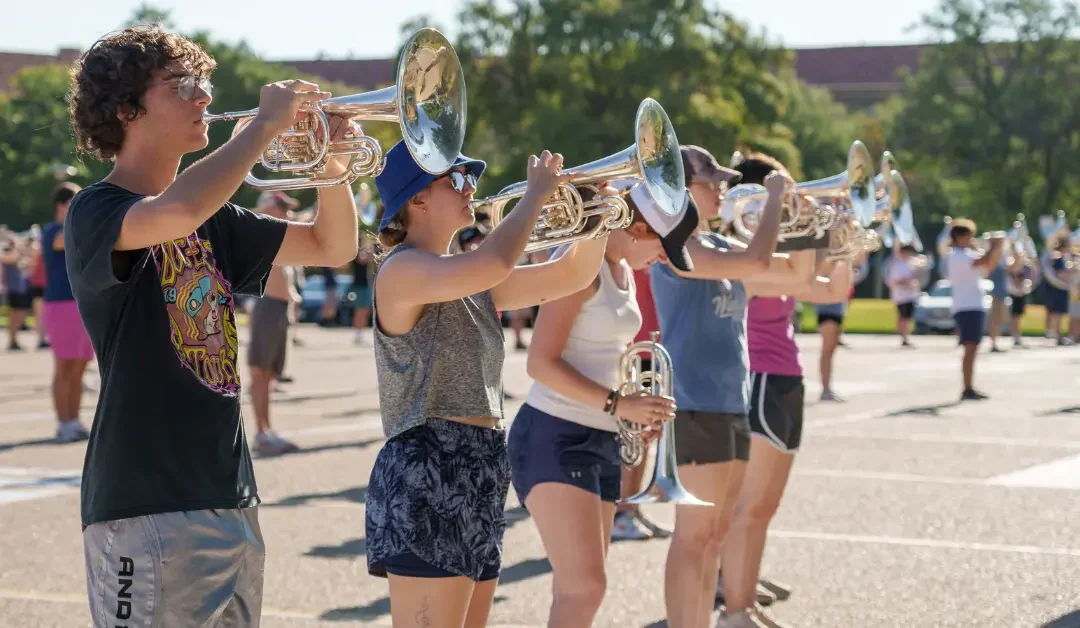
I have stood on a lot of sidelines watching a lot of shows end. Most of the time, the crowd claps politely. The announcer reads off the next school, and everyone moves on.
But every so often, there is a different kind of silence right after the last note. In that half second, nobody claps yet. The audience is still inside the feeling the band just gave them.
That half second is the whole game. It means the crowd was not just watching the show. They were feeling it alongside the performers. That is exactly what the best emotional marching band show ideas are built to do.
I wrote last fall about building a show around one of the seven basic plots. That framework still holds up. But plot is structure, not feeling.
A show can hit every beat of a hero’s journey and still leave an audience cold. That happens when the emotional foundation underneath it is thin. So I want to go one layer deeper this time and talk about the emotions themselves.
When a show is built around one of these honestly, an audience simply cannot shake it. These seven ideas are not competitive gimmicks. They are emotional throughlines, and any one of them can carry a full season if you commit to it.
1. Nostalgia
Nostalgia works because it borrows a feeling the audience already has and hands it back to them, dressed in your music. Think childhood, a specific decade, or a place that no longer exists.
The trap with nostalgia shows is playing it too literally. Stacking one recognizable quotation on top of another quickly makes the show feel like a medley instead of a memory.
The better version treats nostalgia as a color, not a soundtrack. Think warm voicings, familiar intervals, and a visual palette that feels lived-in rather than staged. Save the most direct musical quote for the final push, so it lands as a payoff instead of an opening gimmick.
2. Resilience
Resilience shows live or die on contrast. If the music is heroic from measure one, there is nothing to be resilient against. Instead, I want to hear the setback.
Give me a passage that genuinely struggles, thinner instrumentation, and a visual picture that reads as strain rather than power. Then the recovery has somewhere to travel from.
Drill helps carry this one. A formation that fractures and has to rebuild does more emotional work than a company front standing tall the whole time. Save your loudest, most unified moment for after the struggle, not before it.
3. Wonder
Wonder is the hardest of these seven to fake, because it depends on restraint. The instinct is to go big immediately. But genuine wonder needs space to expand into.
Start smaller than feels comfortable. Try a solo voice, an open interval, or a formation that leaves visible negative space on the field. Let the audience lean in before you give them the full picture.
Wonder-based shows also benefit from ambiguity in the visual design. Shapes and colors that suggest something without naming it outright let each audience member fill in their own sense of scale.
4. Loss
This is the one directors hesitate to program most, and I understand why. It is also the one that, done honestly, an audience remembers longer than almost anything else.
Loss does not require a literal narrative of death or grief to land. It can be the loss of a place, a season, or a version of yourself.
Musically, this usually means real space. Give the show rests that are allowed to be uncomfortable, and a closing phrase that does not resolve as neatly as the audience expects. The mistake to avoid is tacking on a triumphant ending out of habit.
If the show is about loss, let it end there. Earned sorrow is more memorable than an unearned recovery.
5. Hope
Hope is easy to write badly, since it so quickly slides into generic uplift. What separates a hope-based show that actually connects is specificity: hope for something, not hope in the abstract.
Anchor the show to a concrete image, a sunrise, a seed, or a first step. Let every musical and visual choice serve that specific picture rather than a vague feeling of positivity.
Pacing matters more here than in almost any other emotional category. Hope that arrives too early in the show reads as naive. Hope that has to be earned across eight minutes reads as true.
6. Transformation
Transformation shows ask the most of your ensemble. The identity of the group has to visibly shift from the opener to the closer.
That means committing to real contrast in tone, tempo, and visual language between the beginning and end states, not just a louder final chord. I like using a recurring musical or visual motif for this.
Let it appear early in an unfinished or fragile form, then return transformed in the last minute. This gives the audience a concrete marker of how far the show has traveled. That marker is what makes transformation shows feel satisfying instead of just different.
7. Belonging
Belonging is the quietest of the seven. It is often the one that resonates most with the performers themselves, even when the audience cannot name it.
This is a show about connection: to each other, to a community, and to something bigger than the individual performer. Visually, this favors formations that emphasize the group over the soloist, like unison movement and shared phrasing between sections.
Musically, it rewards tight voicing and blend over flashy individual features. A belonging show does not need a dramatic climax to work. It needs the ensemble to look and sound like it means what it is playing.
Choosing the right emotional foundation for your program
None of these seven exist in isolation. Most successful shows lean primarily on one and borrow moments from another. Think resilience with a thread of belonging, or nostalgia with an undercurrent of loss.
The point is not to pick the “correct” emotion. Instead, pick one honestly. Let it govern every design decision, from the music you select to how you pace the final thirty seconds on the field.
I go into the practical mechanics of that process, drill, visual pacing, and structure, in my complete guide to crafting engaging marching band shows. There is also real research behind why this matters.
Music researchers who study what elicits music-evoked nostalgia have found that specificity and personal relevance predict emotional response far more reliably than volume or tempo. That tracks with what I see on the field every fall.
On the ensemble side, NAfME’s own guidance on motivating ensembles makes a similar point. Performers invest more fully in music that connects to something real. That is exactly why I put so much weight on retention strategies that start with what the show means to the kids playing it. What it sounds like from the stands matters less.
FAQ: emotional marching band show ideas
What makes a marching band show emotionally memorable?
A show becomes emotionally memorable when every design choice, music, drill, pacing, and visual language, serves one clear emotional idea instead of several competing ones. Audiences remember specificity, not volume. They respond to a concrete image or feeling they can recognize, built with restraint and paid off at the right moment.
Do emotional shows perform worse competitively than high-energy shows?
Not inherently. Judges respond to the same contrast and pacing that moves an audience. The risk is not emotional content itself. It is under-executing the visual and musical craft that makes an emotional idea legible from the stands. A well-built resilience or transformation show has all the same effect potential as a purely entertainment-driven one.
Can a young or developing program take on an emotionally heavy theme like loss?
Yes, as long as staff handle the theme honestly rather than dramatically. Loss and resilience shows do not require advanced technical demands to work. What they require is restraint in the design. Let the ending sit in the feeling rather than resolve it into a generic triumphant close.
More on emotional marching band show ideas
How do I pick which of these seven fits my program this season?
Start with what is actually true for your students this year rather than what looks impressive on paper. A program coming off a hard year often has genuine resilience or belonging built in already. A program with a lot of seniors graduating might have real nostalgia to draw on. The most convincing version of any of these seven is the one closest to your students’ actual experience.
Should the drill design change based on which emotion I’m building toward?
Yes. Wonder favors negative space and asymmetry that gives the eye room to explore. Belonging favors unison and tight ensemble shapes over featured soloists. Resilience benefits from formations that visibly fracture and rebuild. Treat drill as another instrument for the emotion, not just a visual backdrop to the music.
What is the biggest mistake directors make when trying to build an emotional show?
Reaching for the emotional payoff too early. Hope, wonder, and transformation in particular lose their power when the show hands the audience the “big feeling” too soon. Earn it across the full arc instead. Pacing is what turns an emotional idea into an emotional experience.
About the Author
Evan VanDoren is a composer, arranger, conductor, and former high school band director. Ensembles across the United States and beyond perform his music. In addition, he works with band programs to create music and marching band productions that highlight the strengths of their students and programs.
Recent Comments