
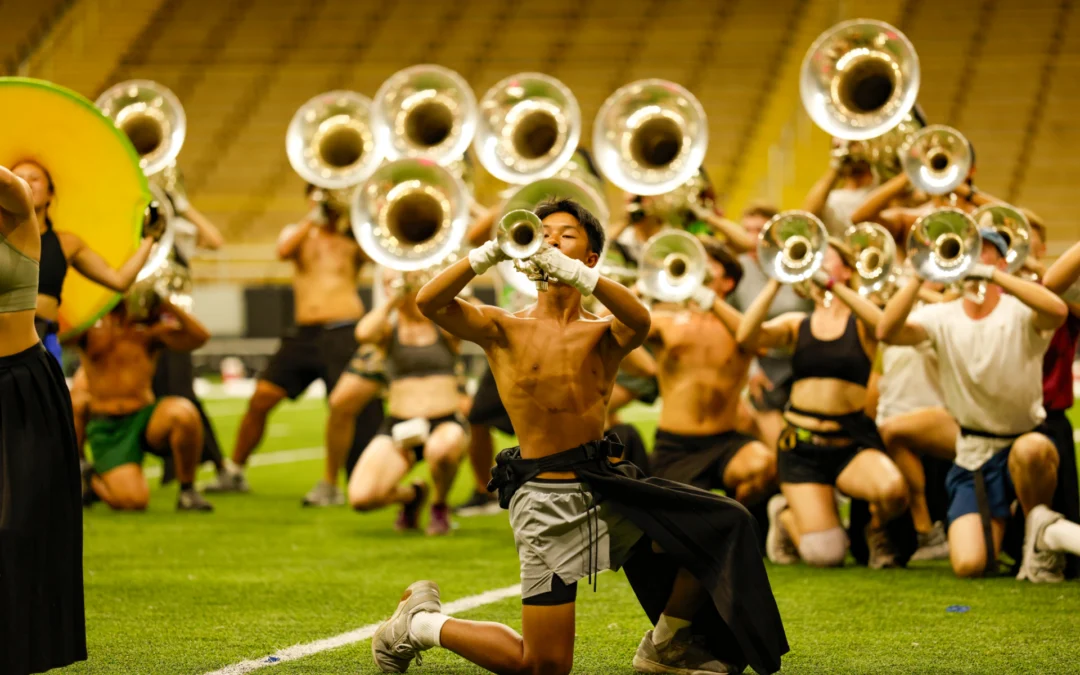
A handful of simple concepts can improve the sight and sound of your marching band more than any single new drill or piece of music. Check out the second portion of my chat with John Denis, Assistant Professor of Music Education at Texas State University. We continue our conversation about those concepts, and specifically how your band can put them to work next year.
If you missed the first portion of this podcast, you can find it by clicking here.
Who John Denis Is
John Denis is an Assistant Professor of Music Education at Texas State University. He teaches upper-level music education courses there, and he researches music pedagogy. He holds degrees from Texas Tech University and the University of North Texas. He’s also published in peer-reviewed journals, including Update: Applications of Research in Music Education and Contributions to Music Education.
He hosts Program Notes too. It’s a podcast built to help pre-service and in-service band directors find success in their own classrooms, and that’s the show this conversation comes from. In it, John and I cover some of the same territory I’ve touched on here before, but from his angle as both a researcher and a working music educator.
The Sight and Sound of Your Marching Band, Defined
It’s a phrase that gets used loosely, so it helps to define it. Sight is what the drill communicates: shapes, spacing, and the visual pacing of the show. Sound is everything the ensemble produces musically, from balance to phrasing to raw tone quality. Neither one exists in isolation on a competition field. So treating them as separate problems is usually why progress stalls.
Music for All’s overview of general effect makes this point well. Visual design, in their framing, should be driven by the music, not layered on top of it afterward. So when a program’s sight and sound feel disconnected, the fix usually isn’t more visual effort or more musical polish on its own. Instead, it’s making sure the two reinforce each other from the start.
I’ve written before about ensemble timing in marching band shows, which sits right at that intersection. A band that moves together and a band that plays together are, in practice, the same problem solved twice.
Simple Concepts That Move Both at Once
None of what John and I discuss in this episode requires new equipment or a rewritten show. My rehearsal strategies for marching band shows cover the framework these concepts fit inside. My post on seven key concepts for knock-out performances goes deeper into a few of the specific ideas John and I touch on here.
Instead, the biggest gains tend to come from small, repeatable habits. That includes how you sequence a rehearsal block, how you cue attention before a run-through, and how consistently you connect a visual correction back to the music that drives it. These small habits compound over a season in a way that one big overhaul rarely does.
If your first contest of the year is still ahead of you, my tips for standing out at UIL Area contest also covers some of the same ground, from a competition-readiness angle.
Listen to the Full Conversation
You can hear the full episode, Episode 29 of Program Notes, on SoundCloud. John and I get specific about what to try first. So it’s worth a full listen rather than just the summary here.
Thanks again to John Denis for having me on Program Notes, and for the work he does preparing new music educators for the classroom.
Frequently Asked Questions
Who is John Denis?
John Denis is an Assistant Professor of Music Education at Texas State University. He also hosts Program Notes, a podcast for pre-service and in-service band directors, and he holds degrees from Texas Tech University and the University of North Texas.
What is the Program Notes podcast?
John Denis hosts Program Notes. The podcast features interviews and discussions meant to help band directors, especially those early in their careers, succeed in the classroom.
What does “sight and sound” mean in a marching band context?
Sight refers to the visual side of a show: drill, spacing, and movement. Sound refers to the musical side: balance, tone, and phrasing. The two work best when you design and rehearse them together, rather than as separate problems.
Do I need new drill or new music to improve my band’s sight and sound?
Not usually. Most of the improvement available to an established program comes from how you rehearse and reinforce existing material, not from replacing it.
Where can I hear Part 1 of this conversation?
You’ll find it linked at the top of this post, or directly on my blog.
Where can I hear Part 2 of this conversation?
Part 2 is available on SoundCloud as Episode 29 of Program Notes.
Evan VanDoren is a composer, arranger, conductor, and former high school band director. Ensembles across the United States and beyond perform his music. In addition, he works with band programs to create music and marching band productions that highlight the strengths of their students and programs.
Have a question about something on the podcast? Feel free to contact me by clicking here!
To access more valuable podcasts on this subject, and more, visit Program Notes: The Beginning Band Director Podcast by clicking here!
Recent Comments